Markets Stay Cautious as US-Iran Tensions Linger and Oil Swings
A volatile European session saw oil spike, equities tread water, and the dollar dip as traders parsed mixed signals from US-Iran diplomacy.
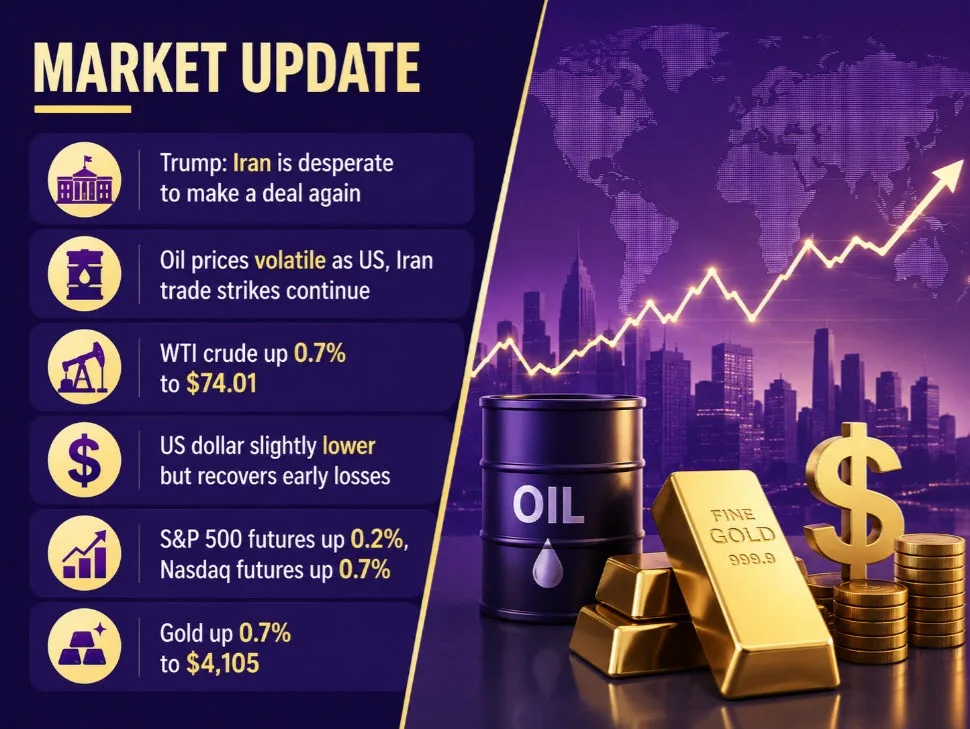
Global markets entered a holding pattern during Monday's European session, with investors reluctant to make bold moves as the US-Iran standoff continued to generate conflicting headlines. President Trump's assertion that Tehran had reached out seeking a deal offered a momentary lift to risk sentiment — but the pattern felt familiar enough to keep traders on edge rather than encouraged.
The parallel to earlier ceasefire negotiations was hard to ignore. A similar round of diplomatic overtures preceded the last truce, yet more than a month on, the same escalation-and-dialogue cycle appears to be repeating. That dynamic creates a market environment defined not by resolution but by chronic uncertainty — where any headline can shift asset prices sharply in either direction, and participants price in the possibility of both breakthrough and breakdown simultaneously.
Read more Micron Stock Slides Toward Worst Monthly Loss in Over a Decade →
Oil remained the most visible pressure point. WTI crude whipsawed through the session, briefly touching around $72.40 before recovering to trade up 0.7% at $74.01, reflecting how supply-disruption fears are never far from the surface when US-Iran tensions flare. Meanwhile, gold extended its run to $4,105, up 0.7%, reinforcing its role as the preferred hedge in geopolitically uncertain environments. Silver added 1.1% to reach $58.98.
Equity futures suggested cautious optimism rather than conviction. S&P 500 futures edged up 0.2% while Nasdaq futures gained 0.7%, partly driven by hopes that chipmakers could recover after recent weakness — Micron and Sandisk were each up roughly 5% in pre-market trading. The US dollar, which initially softened on Trump's deal comments, largely recovered, with EUR/USD retreating from a session high of 1.1450 back toward 1.1425. Ten-year Treasury yields climbed 2 basis points to 4.587% after an earlier dip, underscoring the market's unresolved tension between safe-haven demand and risk appetite.
The ECB added a layer of complexity for European investors, with accounts from recent meetings showing all members viewed inflation risks as tilted to the upside — even as policymaker Escriva cautioned that the central bank cannot recalibrate monetary policy in response to every geopolitical twist. Continue reading at Forexlive.