Software Stocks and Bitcoin Split: What the Divergence Signals
A rare decoupling between software equities and bitcoin raises questions about crypto's role in diversified portfolios.
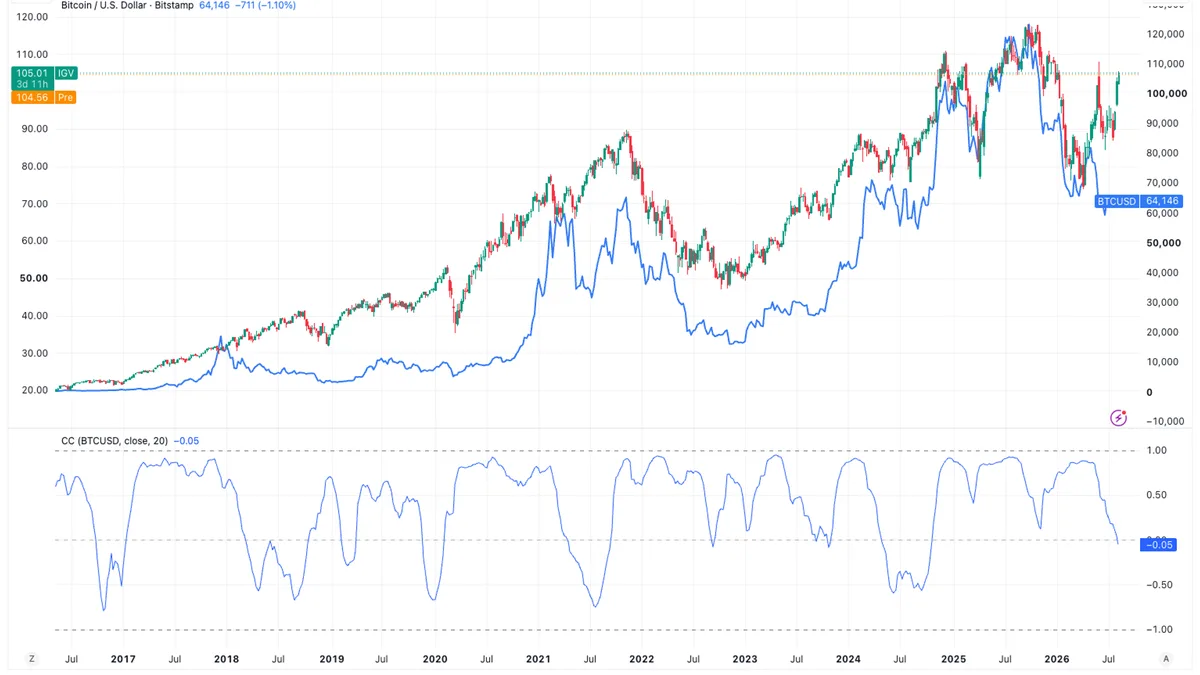
For much of the past several years, bitcoin and technology-adjacent equities — particularly software stocks — have moved in rough lockstep, both rising and falling with shifts in risk appetite, interest rate expectations, and macro sentiment. That correlation made intuitive sense: both asset classes attract growth-oriented investors willing to tolerate volatility in exchange for outsized returns. When that relationship breaks down, as it appears to be doing now, markets take notice.
The divergence matters because it complicates a narrative that institutional investors have leaned on heavily — that bitcoin functions as a kind of high-beta tech trade, amplifying the moves of the Nasdaq in either direction. If software stocks can decouple meaningfully from bitcoin, it suggests the two asset classes may be responding to different fundamental drivers, or that bitcoin is developing its own distinct market microstructure independent of traditional equity flows.
Read more Trump Claims Hormuz 'Control' as Rocket Lab Earnings Disappoint →
There are several plausible explanations worth considering. Software equities are sensitive to earnings revisions, AI-driven revenue expectations, and enterprise spending cycles — factors that have little bearing on bitcoin's supply schedule or on-chain demand dynamics. Bitcoin, meanwhile, is increasingly influenced by its own idiosyncratic catalysts: spot ETF inflows, halving cycles, sovereign adoption signals, and shifts in stablecoin liquidity. When these forces pull in opposite directions, the historical correlation can rapidly unwind.
For portfolio constructors, a sustained divergence would be genuinely significant. It could restore bitcoin's theoretical value as a non-correlated asset — a property that critics argued had eroded during the 2020-2022 macro regime, when virtually every risk asset moved together. Renewed independence could attract a different class of allocator, one interested in bitcoin not as leveraged tech exposure but as a structurally separate store of value.
Whether this divergence proves durable or reverts to historical norms remains the central question. Short-term dislocations between correlated assets are common and often self-correcting. Sustained separation would require a more fundamental re-rating of what bitcoin actually represents in a modern portfolio context. Continue reading at CoinDesk.